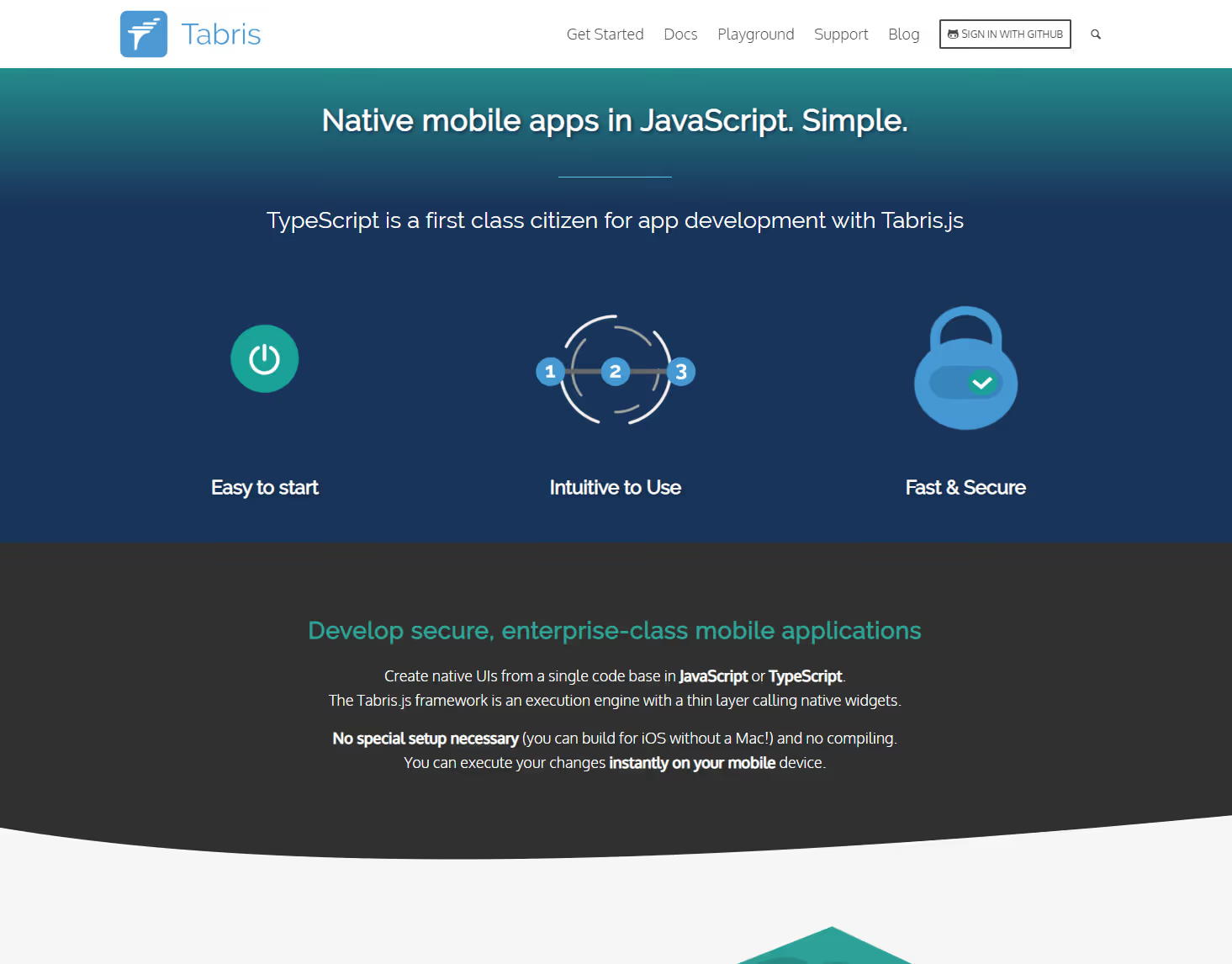
Tabris.js – Technology for Native Mobile Apps in JavaScript
Tabris.js is a modern framework that enables the creation of native mobile apps from a single codebase using JavaScript or TypeScript. This solution allows developers to leverage the potential of web languages to build secure, high-performance enterprise apps with a native look and feel, while maintaining the simplicity and flexibility of the development process. As a developer, I designed and implemented the Tabris.js website, integrating advanced technical solutions to highlight the framework’s innovation and facilitate access to its documentation. Below are the details of the implementation and the technologies used.
The Goal of Tabris.js and its Audience
The Tabris.js website was created for the framework of the same name – a tool that simplifies the development of native mobile apps, eliminating the need for complex configuration and specialized hardware, such as a Mac for iOS development. Its goal is to present the framework’s key features, such as rapid prototyping, high UI performance through native widgets, and support for enterprise-grade apps. The platform is targeted at individual developers, enterprise teams, and businesses looking for efficient solutions to build secure mobile apps. My task was to develop a website that reflects these advantages through a robust technical infrastructure.
Technical Functionalities of Tabris.js
As part of the project, I implemented advanced technical solutions that support the goals of the Tabris.js website:
- Responsiveness and Accessibility – Frontend architecture based on Next.js with Server-Side Rendering (SSR), ensuring compatibility with mobile and desktop devices, compliant with WCAG 2.1 standards.
- Framework Documentation – Dynamic documentation sections loaded via GraphQL, rendered in React with Incremental Static Regeneration (ISR) optimization for fast access.
- Contact Form – Inquiry mechanism with server-side validation, XSS/CSRF protection, SMTP integration, and lead saving in a MongoDB database with AES-256 encryption.
- Technical SEO – Optimization for key phrases (e.g., “native mobile apps JavaScript”), with dynamic XML sitemap generation and accelerated indexing via Google Indexing API.
- Backups and High Availability – Automatic backups to Amazon S3 with cross-region replication, versioning, and Zstandard compression for operational continuity.
- Performance – Server-side caching with Varnish, multimedia optimization by Cloudflare with AVIF format and support for HTTP/3 with QUIC.
- Interactive Demo – A module presenting the framework’s capabilities with simulation of native widgets in WebAssembly, cached in Redis for low latency.
Technical Challenges and Solutions
During the implementation of the Tabris.js website, I encountered several complex technical challenges, which were solved as follows:
- Documentation Load – Extensive framework documentation caused loading delays. I implemented Redis with persistence for query caching and Elasticsearch for fast searching of code examples.
- Demo Optimization – Native widget simulation in WebAssembly slowed down the page on mobile devices. I applied Fastly CDN with Brotli compression and lazy loading via the Intersection Observer API.
- Dynamic Updates – Frequent documentation and demo updates did not scale under high traffic. I utilized RabbitMQ for asynchronous processing of changes and server-side throttling.
- Stale Cache – New versions of documentation were not immediately reflected. I implemented Varnish with purge on webhooks and Edge Side Includes for dynamic sections.
Technologies Used
To build and maintain the Tabris.js website, I used the following technologies:
- Next.js – Framework for SSR and ISR rendering, optimizing site performance and SEO.
- Yoast SEO – Metadata optimization, XML sitemap generation, and automatic search engine notifications of updates.
- UpdraftPlus – Automatic backups to Amazon S3 with cross-region replication and AES-256 encryption.
- Cloudflare – CDN with Argo Smart Routing, Brotli compression, and DDoS protection through request limiting.
- Redis – In-memory caching with sharding and persistence for documentation and demo.
- Varnish – Server-side caching with custom VCL, supporting grace mode and ESI for dynamic blocks.
- Lighthouse – Automatic Core Web Vitals audits integrated into the CI/CD process in GitLab.
- RabbitMQ – Task queuing, such as demo updates and email delivery, with a retry mechanism.
- Elasticsearch – Search engine for documentation with fuzzy matching and code example aggregation.
- Fastly – Additional CDN for parallel multimedia distribution with geographical optimization.
- WebAssembly – Technology for simulating native widgets in the browser with performance optimization.
Management and Technical Support
The Tabris.js website is a project requiring continuous monitoring and optimization to support developers and businesses in adopting the framework. I regularly update the system and plugins, performing tests on a staging environment with full backups on Amazon S3. I use Cloudflare, Redis, and Fastly to ensure high performance with global traffic, while Varnish and RabbitMQ stabilize dynamic processes such as documentation updates. I monitor indexing with Elasticsearch, optimize NoSQL queries with indexes and manage cache during content changes. The platform can be expanded with additional functionalities – such as integration with CI/CD tools, a training module, or a section for enterprise examples – to continue supporting Tabris.js in simplifying native mobile app development. Planning a website for your framework or tech product? Need a scalable platform with advanced technical support? Contact me to discuss details and create a solution that meets your requirements.