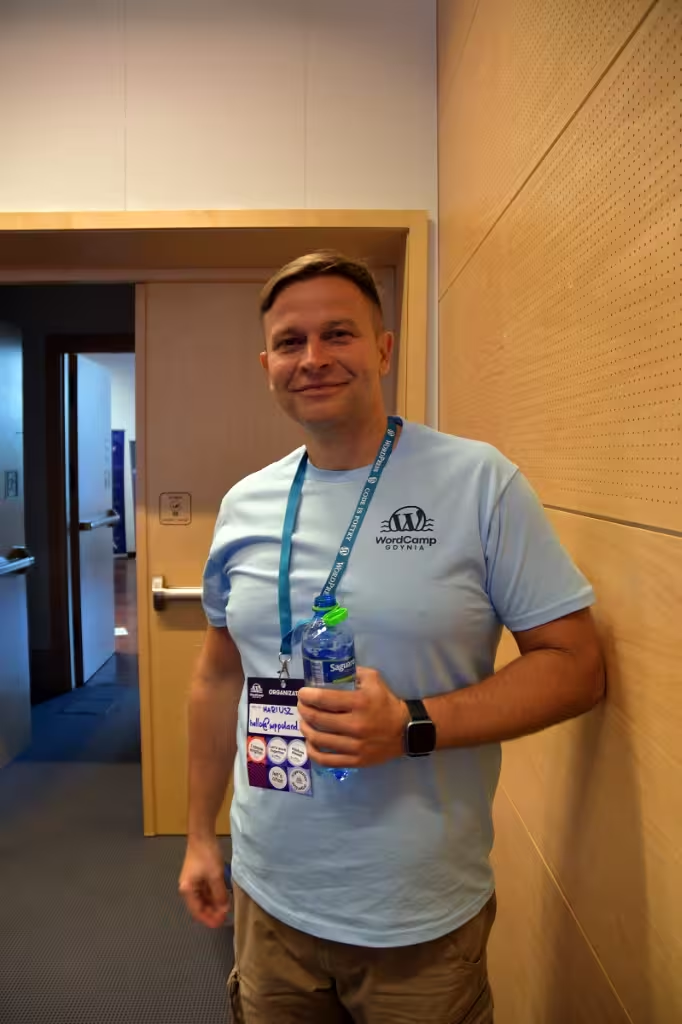
Who: Mariusz Szatkowski, Senior WordPress Specialist with 20+ years experience handling complex issues, emergencies, and enterprise solutions.
What: Expert WordPress troubleshooting, crisis management, WooCommerce scaling, custom plugin development, security audits, and Core Web Vitals performance engineering.
Where: Remote specialist services worldwide from Gdynia, Poland. Emergency response available 24/7 for critical issues.
How much:
- Hourly Rate: individual quote
- Emergency Fix: individual quote
- Security Cleanup: individual quote
- Performance Audit: individual quote
- Monthly Retainer: individual quote
- Response Time: 2-24 hours
WordPress specialist & technical expert
Sometimes you encounter WordPress issues that require more than just general knowledge. Whether it’s solving an urgent site failure, implementing complex custom logic, or optimizing a high-traffic store, standard developers might struggle. As specialized WordPress experts, we solve the problems others can’t. Broken WooCommerce stores go straight to the WooCommerce rescue sprint. New builds and full developer scope sit on the WordPress developer pillar.
When do you need a specialist?
If your digital agency or internal team is stuck, we step in.
Crisis Management
Site down? Hacked? Critical error after an update? We diagnose and fix urgent issues rapidly.
Custom Development
We don't just install plugins. We write custom code, build APIs, and develop bespoke themes and features.
Advanced Optimization
We optimize Core Web Vitals, database queries, and server configurations for maximum speed.
Enterprise WooCommerce
Scaling large e-commerce stores, integrating ERP systems, and handling high concurrent traffic.
What a specialist actually knows that a generalist doesn’t
The difference between a competent web developer and a WordPress specialist shows up in problems that don’t have a Stack Overflow answer. A generalist who picks up WordPress between React projects can build a theme and wire up a contact form. A specialist has spent enough time inside the platform to know where the bodies are buried.
A few examples from real client work this year:
- A B2B publisher’s admin panel was taking 4-7 seconds per request. The site felt fine on the front end because page caching hid the problem. The cause was the
wp_optionstable:autoloadhad grown to 12 MB because three deactivated plugins had left option rows behind, and one active plugin was writing a serialised array of cron events on every admin pageview. Dropping autoloaded options to 800 KB cut admin TTFB by roughly 600 ms. A generalist would have looked at PHP-FPM workers and added more memory. - A membership site needed editors who could publish in three categories but could not touch a fourth. The fourth was tied to a paywall taxonomy with its own capability mapping. Solving it cleanly required
map_meta_caponedit_postplus a custom post type capability set tied to the taxonomy term, not user role. ACF Pro alone does not handle this; it stops at field-level permissions. - A client moved from a single installation to multisite with 8 networks. Shared user tables across networks meant each user had to keep one identity but receive different roles per site, plus a super-admin layer that did not auto-propagate to new networks. We wrote a small mu-plugin that reads role assignments from a central options table and applies them on
wpmu_new_blog. There is no plugin for that.
These are not unusual WordPress problems. They are normal once a site is past its first year. They look like edge cases only because most agencies never get past the surface of the platform.
The skills that matter when WordPress gets complicated
Specialist work tends to land on a handful of the same APIs over and over: WP_Query and the posts_clauses filter for queries that need joins or custom WHERE logic, register_rest_route with proper schema and permission_callback instead of returning __return_true, the block editor’s InnerBlocks and block patterns for editorial teams that need structured content without freeform Elementor sprawl, pre_get_posts for changing main query behaviour without breaking pagination, and the capability and meta-capability system for anything beyond five user roles.
Plugin internals matter too. Knowing how WooCommerce stores order data after the HPOS migration, how Yoast queues sitemap regeneration, how Polylang or WPML rewrite query parameters, and how popular caching plugins interact with the REST API is the difference between guessing and diagnosing.
Where specialist work actually starts
Most engagements begin in one of four states, so the first phase is rarely “build something new”. It is “figure out what is already broken and decide what to keep”.
Custom block development beyond what page builders can do
Editorial teams keep asking for the same thing: a block they can configure with consistent styling, locked structure, and editor previews that match the front end. That is InnerBlocks with allowedBlocks and a template lock, plus a block.json registration with proper attribute schemas and an edit component written in React. Page builders cannot give you that because their structure lives outside the post content. When the editor team grows past two people, freeform builders become a content-governance problem; native blocks solve it.
Block patterns and block variations cover the rest. A pattern library mapped to brand components means new landing pages get assembled in 20 minutes by marketing, not three days by a developer. The investment pays back inside the first quarter.
REST API extensions that hold up in production
Custom endpoints are not hard to register. Doing them properly is. That means a real args schema with validate_callback and sanitize_callback per parameter, permission_callback tied to a capability check rather than a logged-in check, and rate limiting through a transient or a small custom table when the endpoint is exposed to anonymous traffic. It also means versioning the namespace from day one (yourbrand/v1) so the next breaking change does not require a coordinated mobile release.
Most WordPress REST API problems I inherit come from endpoints that returned permission_callback => '__return_true' because the developer wanted to ship and assumed nginx would handle the rest. It does not.
Multisite, capabilities, and user-role mapping
Multisite is where most generalists tap out. The shared wp_users and wp_usermeta tables, the per-site capability storage in wp_X_capabilities user meta keys, the difference between super admin and network admin, and the way current_user_can resolves against the active blog all create real architectural decisions. A site moving to multisite needs a written plan for who owns what, how new networks get provisioned, how plugins activate per network or per site, and how cross-network reporting works.
The 8-network migration mentioned earlier took three weeks. Two of those weeks were role mapping and content migration scripts. The actual wp-config.php constants and DNS work was a single afternoon.
Performance work that targets WordPress-specific causes
Generic performance advice (lazy load images, enable HTTP/2, run a CDN) applies to any website. WordPress-specific performance work is different: pruning the autoload row in wp_options, finding the post meta keys that are loaded on every front-end request because a plugin called get_post_meta($post_id) without a key argument, killing duplicate WP_Query calls in the header by passing the same query through pre_get_posts instead, switching expensive meta_query lookups to taxonomy queries, and replacing posts_per_page => -1 with proper pagination wherever a developer left it in.
Object caching with Redis matters, but only after the database layer has been cleaned up. Putting Redis in front of a 12 MB autoload table just caches the wrong thing faster.
Security work after a compromise
Recovery from a real compromise is a forensic exercise before it is a cleanup. The first step is reading the access log for the entry point and the file integrity diff against a clean checkout of core, the active theme, and pinned plugin versions. Most reinfections happen because someone restored from a backup that was already compromised, or because a backdoor was hidden in wp_options (a base64 payload set as an autoloaded option) rather than in a file. A wp-cli scan of the options table for suspicious patterns is part of every cleanup we do.
After cleanup, hardening is the boring but necessary part: disabling file editing in admin, restricting xmlrpc.php at the web server, locking REST user enumeration, rotating all API keys and database credentials, and putting the site behind a WAF with rules tuned for WordPress attack patterns rather than generic OWASP rules.
A second opinion on a site that already broke
When a site is slow, throwing fatal errors, or coming back from a compromise, the useful first move is finding out what is actually running under it. Send admin access, the hosting details, and a short note on when the trouble started. What comes back is a ranked list of causes split into fix now and safe to postpone, so you can decide whether the answer is repair or rebuild. Scope and cost are agreed individually.
Request a diagnosisTechnical audit services
Comprehensive audits identify improvement opportunities.
Security vulnerability assessment
Security audits examine all attack surfaces. Plugin vulnerabilities, theme security, and core WordPress settings all receive attention. Known vulnerabilities get identified and prioritized for remediation.
Configuration review assesses security settings. File permissions, database security, and server configuration all affect overall security. Recommendations address configuration weaknesses.
Access control review examines user permissions. Administrative access, role assignments, and authentication methods all require evaluation. Proper access control limits attack impact.
Performance analysis
Performance audits analyze all performance factors. Server response times, database query efficiency, and frontend delivery speed all get measured. Findings guide optimization efforts.
Core Web Vitals assessment evaluates Google’s metrics. LCP, CLS, and INP measurements reveal user experience issues. Optimization recommendations improve these critical metrics.
Caching strategy review examines current implementations. Proper caching dramatically improves performance. Recommendations optimize caching for specific workloads.
Code quality review
Code audits examine custom code quality. Theme and plugin code gets reviewed for security vulnerabilities, performance issues, and maintainability problems. Recommendations address code weaknesses.
Best practices evaluation examines development approaches. Coding standards, documentation, and version control practices all affect long-term maintainability. Improvements enhance future development efficiency.
Technical debt assessment identifies accumulated problems. Deprecated functions, security vulnerabilities, and architectural weaknesses accumulate over time. Prioritized roadmaps address technical debt systematically.
Maintenance and support
Ongoing maintenance prevents problems.
Proactive maintenance
Regular updates keep WordPress current. Core, plugin, and theme updates get applied systematically. Testing procedures verify compatibility before production deployment.
Monitoring systems detect problems early. Uptime monitoring, performance tracking, and security scanning identify issues before they become critical. Prompt attention prevents minor issues from becoming major problems.
Backup verification ensures recovery capability. Regular backup testing confirms restoration processes work when needed. Reliable backups provide peace of mind.
Support services
Ongoing support addresses ongoing needs. Developer hours cover routine changes, troubleshooting, and new feature development. Predictable costs support budget planning.
Priority support ensures quick response. Critical issues receive immediate attention. Business-impacting problems get resolved quickly.
Training and knowledge transfer let teams. Documentation, training sessions, and video tutorials help teams manage sites independently. Reduced dependence on external support lowers long-term costs.
Get started
Ready to work with a WordPress specialist? Contact us to discuss your challenges. We’ll assess your situation and propose solutions.
Our specialized expertise addresses complex WordPress challenges. Let’s solve your difficult problems together.
Engagement models
Specialists offer various engagement options.
Project-based work
Defined-scope projects work well for specific needs. Clear deliverables, timelines, and pricing. This model suits well-defined requirements with predictable outcomes.
Emergency projects address urgent issues. Critical site problems receive immediate attention. Rapid response minimizes business impact.
Consultation projects provide expert guidance. Code reviews, architecture assessments, and strategy planning benefit from specialist perspective.
Retainer relationships
Monthly retainers provide ongoing access to specialist expertise. Pre-allocated hours cover continuous development, troubleshooting, and optimization. Priority scheduling ensures timely attention.
Retainers suit organizations with ongoing WordPress needs. Predictable costs support budget planning. Relationship depth enables efficient project execution.
Hybrid arrangements
Combining project and retainer work addresses varied needs. Specific initiatives get project treatment. Ongoing maintenance and development use retainer hours. Flexibility within structure maximizes value.
Custom arrangements suit unique requirements. Discuss your specific situation to design optimal engagement.
Industry expertise
Specialists serve diverse industries with unique requirements.
E-commerce
Online stores require specialized knowledge. WooCommerce expertise addresses platform-specific challenges. Payment processing, inventory management, and checkout optimization require deep knowledge.
High-volume stores face scaling challenges. Performance optimization handles traffic spikes. Infrastructure design supports business growth. Security protects customer data and transaction information.
B2B e-commerce introduces additional complexity. Wholesale pricing, customer tiers, and quote systems require custom development. Integration with ERP and accounting systems simplifies operations.
Media and publishing
Content sites require efficient publishing workflows. Editorial processes, content management, and distribution systems benefit from specialized development. Advertising integration maximizes revenue.
High-traffic sites demand robust infrastructure. Caching, CDN distribution, and database optimization handle visitor volumes. Performance optimization improves user experience and ad viewability.
Membership sites require access control and content delivery. Subscription management, payment processing, and content gating require integrated development. User experience affects retention and revenue.
Healthcare
Healthcare websites face strict compliance requirements. HIPAA considerations affect data handling. Security requirements exceed standard practices. Accessibility standards ensure inclusive access.
Patient portals require secure information delivery. Appointment scheduling, health information access, and communication systems require integrated development. Privacy considerations affect all functionality.
Medical practices need professional online presence. Provider directories, service information, and patient education content require systematic organization. Reputation management supports practice growth.
Financial services
Financial websites require enhanced security. Regulatory compliance affects functionality. Data protection exceeds standard requirements. Trust signals affect visitor confidence.
Complex content requires sophisticated management. Investment information, account access, and communication systems require integrated development. Performance affects user experience and conversion.
Quality assurance
Specialists prioritize quality throughout engagement.
Testing practices
Comprehensive testing verifies functionality. Unit testing, integration testing, and end-to-end testing each serve different purposes. Automated testing reduces regression issues.
Performance testing validates optimization. Load testing simulates traffic to verify scalability. Real-user monitoring tracks actual performance metrics.
Security testing identifies vulnerabilities. Automated scanning finds known issues. Manual testing identifies architectural weaknesses. Penetration testing validates defenses.
Documentation
Code documentation enables future maintenance. Inline comments, README files, and API documentation all contribute to understanding. Well-documented code reduces future development costs.
User documentation supports content management. Training materials, video tutorials, and user guides help teams manage sites effectively. Clear instructions reduce support requests.
Process documentation ensures consistency. Deployment procedures, rollback plans, and incident response playbooks guide future actions. Documentation preserves institutional knowledge.
Communication
Regular updates keep stakeholders informed. Progress reports, issue notifications, and milestone communications maintain transparency. Clear communication prevents misunderstandings.
Professional correspondence reflects well on engagement. Documentation of decisions, agreements, and outcomes protects all parties. Written records enable future reference.
Escalation procedures handle issues efficiently. Clear paths for concerns ensure problems get addressed appropriately. Good communication prevents small issues from becoming major problems.
Success factors
Successful specialist relationships require specific conditions.
Clear requirements
Well-defined requirements produce better outcomes. Ambiguous needs lead to misunderstandings and rework. Invest time in requirements gathering upfront.
Success criteria clarify expectations. Measurable goals enable objective evaluation. Clear definitions of done prevent scope creep.
Realistic expectations acknowledge constraints. Budget, timeline, and technical limitations all affect outcomes. Honest assessment produces achievable plans.
Effective collaboration
Good communication enables success. Prompt responses, clear questions, and feedback keep projects moving. Collaboration produces better results than isolation.
Trust in specialist expertise produces better outcomes. Micromanagement undermines efficiency. Allow specialists to apply their knowledge effectively.
Reasonable flexibility accommodates changes. Original plans evolve through projects. Adaptability prevents rigid approaches from derailing progress.
Mutual respect
Professional relationships succeed through respect. Fair compensation, clear communication, and appreciation for quality work build long-term relationships.
Value recognition motivates excellence. Understanding of specialist contribution fosters productive partnerships. Respectful treatment ensures priority attention.
Long-term relationships benefit both parties. Repeat business, referrals, and partnership opportunities result from positive experiences. Building relationships creates sustainable success.
Contact us
Ready to work with a WordPress specialist? Contact us today to discuss your needs. We’ll provide detailed proposals outlining solutions and pricing.
Our specialized expertise addresses complex WordPress challenges. Let us help solve your difficult problems and achieve your goals.
The investment in specialist expertise produces measurable returns. Improved performance, enhanced security, and reliable operations all contribute to business success.
Contact us now to begin your specialist engagement. We’re ready to help you succeed with WordPress.
Operational ownership, not just task execution
A serious WordPress specialist is accountable for outcomes, not only for code delivery. That distinction matters when your website is tied to revenue, lead generation, support processes, and brand trust. In many projects the real issue is not one broken plugin, but an accumulation of uncoordinated changes over months or years. One contractor solved a short-term problem, another changed hosting parameters without impact analysis, and then an update exposed hidden conflicts. The specialist role is to reintroduce structure and controlled decision-making.
In practical terms, this means defining a clear change model before implementation. Each non-trivial change should have a business objective, technical scope, risk category, rollback path, and success criteria. It also means prioritising by impact rather than noise. A minor visual bug is rarely as urgent as unstable checkout behaviour, recurring 5xx errors, or broken indexing signals after release.
Sustainable ownership also includes documentation discipline. Teams change. Agencies rotate people. Internal stakeholders move to other roles. If architectural decisions are not captured, the same mistakes reappear and maintenance costs rise. A specialist creates technical clarity that survives team changes, so your platform remains manageable over time instead of becoming “untouchable code”.
Technical audit framework that drives decisions
A useful audit is not a decorative PDF with generic recommendations. It should be a decision instrument that reduces uncertainty and defines a realistic execution order. The process starts with context collection: what is the business objective, where financial loss is occurring, what operational constraints exist, and what timeline is acceptable. A lead-generation site and a high-volume commerce stack need different priorities.
Then the analysis runs across layers. Application layer: theme architecture, plugin interactions, custom hooks, and error surfaces. Infrastructure layer: PHP runtime, web server behaviour, cache strategy, worker limits, and queue bottlenecks. Data layer: query profiles, index quality, table growth patterns, and cron pressure. SEO-technical layer: canonicals, hreflang consistency, sitemap quality, redirect hygiene, and crawlability signals.
Findings are grouped by action horizon: critical now, scheduled next, and strategic later. This removes paralysis and converts technical noise into a business-aligned execution backlog. The audit becomes immediately actionable, and your team can measure progress week by week instead of debating priorities without a shared model.
Security engineering in realistic WordPress environments
WordPress security fails most often because process fails, not because the platform is inherently insecure. Installing a security plugin is not a security programme. Effective protection requires layered controls: identity hygiene, update discipline, runtime protection, backup resilience, and incident playbooks.
Identity hygiene includes MFA, strict admin account minimisation, password policy enforcement, and permission review. Update discipline means staging-first release management and tested rollback, rather than blind production updates. Runtime protection includes hardened server configuration, selective XML-RPC exposure, firewall policy, and behavioural monitoring.
Backup policy must include restore testing. A backup that was never validated is not a backup, it is a hope. Incident response should prioritise containment, root-cause removal, key rotation, and preventive hardening. Fast cosmetic cleanup without forensic understanding usually leads to reinfection. A specialist treats security as an operational system, not a one-off technical patch.
Performance engineering for conversion and stability
Speed optimisation is valuable only when connected to business metrics. Better Lighthouse scores are not a goal by themselves. The goal is lower abandonment, better conversion, improved ad efficiency, and consistent UX under realistic load.
Performance work starts with segmentation: mobile versus desktop, landing templates versus transactional pages, cold cache versus warm cache, and campaign traffic versus baseline traffic. From there, bottlenecks are isolated: render-blocking assets, script contention, oversized media, backend latency, query inefficiency, and third-party script overhead.
Execution should be phased. Phase one delivers fast wins: asset strategy cleanup, image pipeline fixes, critical CSS, and safer cache rules. Phase two addresses structural factors: database pressure, expensive hooks, long task reduction, and integration timing. Phase three adds monitoring with threshold alerts tied to conversion-sensitive pages. This closes the loop between engineering effort and business impact.
WooCommerce scaling patterns that hold under pressure
WooCommerce can scale well, but only with deliberate architecture. At higher order volume, weak assumptions in checkout flow, stock handling, and integration timing become expensive quickly. Failures during peak traffic are especially damaging because they happen when demand is highest.
Scaling work starts from the transaction path. Which steps must be synchronous? Which integrations can be queued? Which validation routines are redundant at checkout time? Moving non-critical operations out of the request path reduces timeout risk and improves payment completion reliability.
Catalogue experience is another pressure point. Layered filters, heavy search queries, and broad product metadata can overload the database. Query optimisation, indexing, object cache strategy, and selective precomputation are often required. Add campaign-readiness planning on top, and the store moves from reactive firefighting to predictable operation during traffic spikes.
Integration architecture and data reliability
Modern WordPress setups are rarely isolated. They exchange data with CRM, ERP, billing systems, marketing automation, and analytics platforms. Integration quality directly affects operational cost and data trust.
Reliable integration design defines ownership of each data object, validation policy, retry strategy, idempotency rules, and error visibility. Without these controls, teams suffer from silent data drift, manual correction loops, and difficult incident triage.
Observability is essential. Business-level logs, correlation identifiers, and alertable failure states turn integrations from black boxes into manageable systems. When an order fails to synchronise, the team should know exactly where and why, within minutes. That operational clarity is one of the highest-value contributions a specialist can make.
If the store is already down or checkout is failing, start with the WooCommerce rescue sprint. After a breach or malware, use the WordPress security audit. For retained care after stabilisation, see the Store Reliability Plan. You can also send a short written brief.