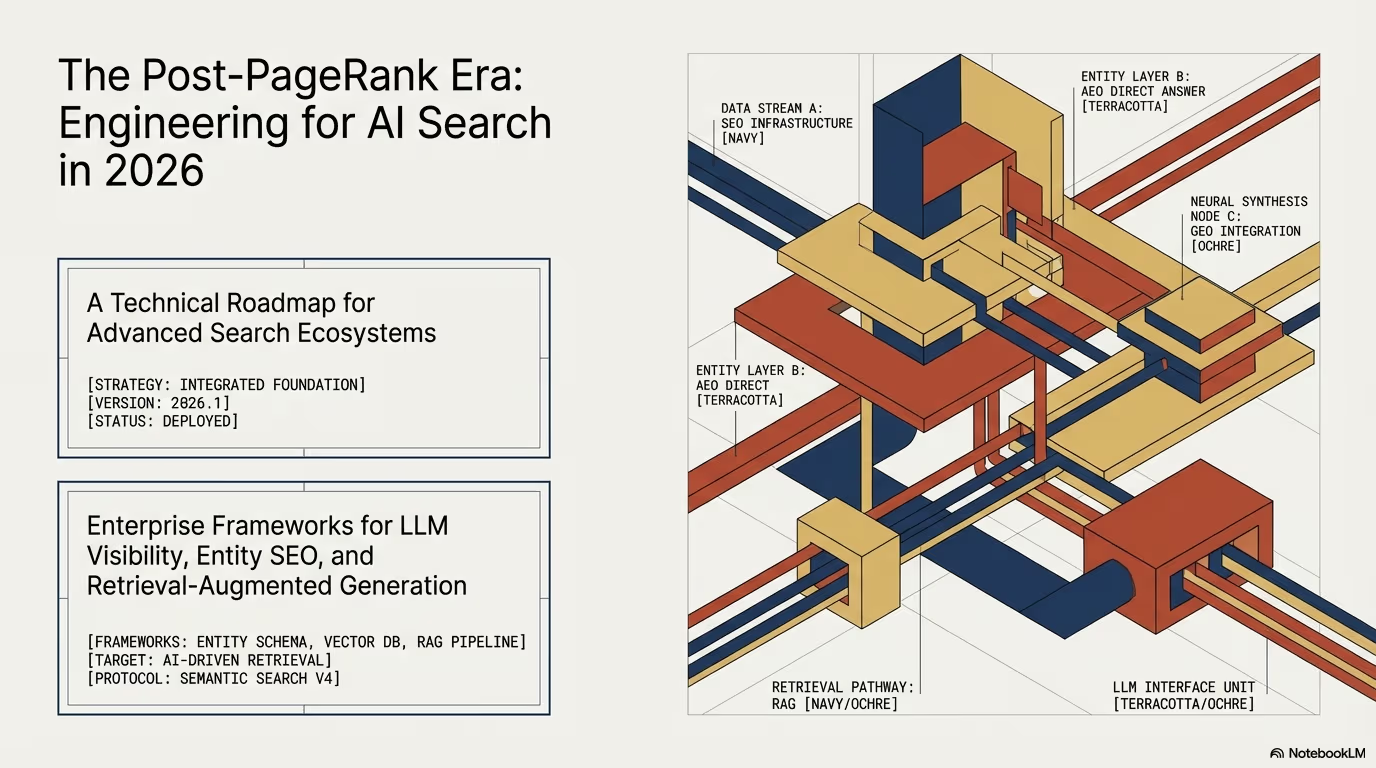
Search is splitting. In 2026, users don’t just search Google - they ask ChatGPT, query Perplexity, use Google AI Mode, and talk to voice assistants. Each of these systems consumes web content differently, but they share one thing: Schema.org structured data helps them understand, trust, and cite your content.
Traditional SEO got you into search results. AEO (Answer Engine Optimization) gets you into AI-generated answers. GEO (Generative Engine Optimization) gets you cited as a source in AI conversations. Schema.org is the bridge between your content and these AI systems.
The AI Search Landscape in 2026
How AI Systems Consume Your Content
| System | How It Uses Schema.org | What It Cites |
|---|---|---|
| Google AI Mode | FAQPage, HowTo, Product for structured answers | Pages with clear E-E-A-T signals |
| ChatGPT (Browse) | Article, Person, Organization for authority | Well-structured, factual content |
| Perplexity | All schema types for fact verification | Content with explicit sources |
| Voice Assistants | Speakable, FAQPage for spoken answers | Concise, answer-first content |
| AI Shopping | Product, AggregateRating, Offer | Stores with complete product data |
Why Schema.org Matters More Than Ever
Without structured data, AI systems must infer meaning from raw text - an error-prone process. With Schema.org, you explicitly tell AI:
- What your content is about (entities, topics)
- Who created it (author credentials, expertise)
- How reliable it is (ratings, reviews, citations)
- What questions it answers (FAQ, HowTo)
- Which parts are most important (Speakable)
This explicit signaling dramatically increases the chance of being selected as an AI answer source.
Schema.org Types That Matter for AI Search
1. FAQPage - The #1 AEO Schema
FAQPage schema directly maps questions to answers - exactly what AI search engines need. When ChatGPT or Google AI Mode encounters a query matching your FAQ, it can cite your answer with high confidence.
{
  "@type": "QAPage",
  "mainEntity": [
    {
      "@type": "Question",
      "name": "How much does a WordPress website cost?",
      "acceptedAnswer": {
        "@type": "Answer",
        "text": "WordPress website costs vary by complexity..."
      }
    }
  ]
}
Best practices for AI-optimized FAQ:
- Answer the exact question in the first sentence
- Include specific numbers, dates, and facts
- Keep answers under 300 words (AI prefers concise)
- Cover the question from multiple angles
2. Speakable - Voice and AI Section Marking
Speakable schema tells AI which sections of your page are most suitable for spoken or AI-generated answers:
{
  "@type": "WebPage",
  "speakable": {
    "@type": "SpeakableSpecification",
    "cssSelector": [".aeo-who", ".aeo-what", ".aeo-pricing"]
  }
}
Mark your most concise, answer-first sections as speakable. AI systems prioritize these sections when generating responses.
3. HowTo - Step-by-Step AI Answers
HowTo schema provides structured instructions that AI can display as formatted steps:
{
  "@type": "HowTo",
  "name": "How to Migrate WordPress to Astro",
  "step": [
    {
      "@type": "HowToStep",
      "name": "Audit current site",
      "text": "Document all content, URLs, and functionality..."
    }
  ]
}
AI shopping assistants and tutorial engines love HowTo schema because it provides clear, actionable information.
4. Product + AggregateRating - AI Shopping
AI shopping assistants (Google AI Mode Shopping, ChatGPT Plugins) use Product schema to recommend and compare products:
{
  "@type": "Product",
  "name": "WordPress Development Service",
  "aggregateRating": {
    "@type": "AggregateRating",
    "ratingValue": "5",
    "ratingCount": "127"
  }
}
Without Product schema, AI shopping assistants cannot include your products in comparison answers.
5. Article + Person - E-E-A-T for AI
AI systems assess author credibility. Article schema with a detailed Person author helps:
{
  "@type": "Article",
  "author": {
    "@type": "Person",
    "name": "Mariusz Szatkowski",
    "jobTitle": "Senior WordPress Developer",
    "sameAs": ["https://linkedin.com/in/...", "https://github.com/..."],
    "knowsAbout": ["WordPress", "WooCommerce", "Headless CMS"]
  }
}6. Entity Linking - Knowledge Graph Connections
The about and mentions properties with Wikidata URLs connect your content to the Knowledge Graph:
{
  "@type": "Article",
  "about": [
    { "@type": "Thing", "name": "WordPress", "url": "https://www.wikidata.org/wiki/Q13166" },
    { "@type": "Thing", "name": "Web Performance", "url": "https://www.wikidata.org/wiki/Q104618838" }
  ]
}
This tells AI systems exactly what entities your content discusses, reducing ambiguity and increasing citation confidence.
Implementing Schema.org for AI on WordPress
Approach 1: Custom JSON-LD (Recommended)
Generate schema programmatically in your theme or components. This gives full control over every property:
// WordPress: output schema in wp_head
add_action('wp_head', function() {
    $schema = [
        '@context' => 'https://schema.org',
        '@type' => 'FAQPage',
        'mainEntity' => get_faq_items()
    ];
    echo '<script type="application/ld+json">' . json_encode($schema) . '</script>';
});Approach 2: Yoast SEO / Rank Math
Both plugins generate basic schema automatically. Yoast’s Schema Aggregation (with Microsoft NLWeb) is emerging as a standard for AI-discoverable schema. However, custom implementation provides more control over entity linking and speakable properties.
Approach 3: Astro / Next.js Components
In headless architectures, schema is generated by frontend components:
---
// Astro: Schema component
const schema = {
  "@context": "https://schema.org",
  "@type": "FAQPage",
  "mainEntity": faqItems.map(item => ({
    "@type": "Question",
    "name": item.question,
    "acceptedAnswer": { "@type": "Answer", "text": item.answer }
  }))
};
---
<script type="application/ld+json" set:html={JSON.stringify(schema)} />robots.txt Configuration for AI Crawlers
Your robots.txt must allow AI crawlers to access your content:
# Allow AI crawlers
User-agent: GPTBot
Allow: /

User-agent: PerplexityBot
Allow: /

User-agent: ClaudeBot
Allow: /

User-agent: anthropic-ai
Allow: /
Without this, AI systems cannot discover your content regardless of how good your schema is.
AEO Content Writing Principles
Answer-First Structure
AI systems extract the first clear answer they find. Structure content with the answer in the opening paragraph:
Bad (for AI): “WordPress is a content management system that was created in 2003 by Matt Mullenweg and Mike Little. It has evolved significantly over the years…”
Good (for AI): “A WordPress website costs between $500 and $50,000 depending on complexity. Simple business sites start at $500-$2,500, while enterprise sites range $10,000-$50,000+.”
Entity Clarity
Be explicit about what entities you’re discussing. Don’t assume context:
Bad: “It’s faster than the alternative and more secure.” Good: “Astro is 4x faster than traditional WordPress and eliminates SQL injection attacks through static frontend architecture.”
Factual Density
AI systems prefer content with verifiable facts:
Bad: “We’re one of the best WordPress agencies with lots of experience.” Good: “WPPoland has delivered 500+ WordPress projects since 2007, with PageSpeed scores averaging 95-100 and a 5/5 client rating from 127 reviews.”
GEO Optimization Checklist
- FAQPage schema on all service and key blog pages
- Speakable schema marking answer-first sections
- HowTo schema for tutorial and guide content
- Product + AggregateRating for service pages
- Article + Person schema with author credentials
- Entity linking (about/mentions) with Wikidata URLs on all pages
- robots.txt allows GPTBot, PerplexityBot, ClaudeBot
- Answer-first content structure on key pages
- Explicit entity references (no ambiguous pronouns)
- Factual density with specific numbers and dates
- Content freshness signals (lastVerified, dateModified)
- llms.txt file for AI-specific site description
Measuring AI Visibility
Direct Monitoring
- Search your brand and key topics in ChatGPT, Perplexity, and Google AI Mode
- Check if your content is cited as a source
- Track which pages get AI citations
Indirect Signals
- Google Search Console: check for traffic from AI-related queries
- Referral traffic from Perplexity (shows as perplexity.ai in analytics)
- Brand mention monitoring across AI platforms
Conclusion
Schema.org is no longer just about Google rich results. It’s the language AI search engines use to understand, trust, and cite your content. In 2026, sites without comprehensive structured data are invisible to the fastest-growing discovery channel.
The investment is straightforward: implement FAQPage, Speakable, HowTo, Product, and entity linking across your site. Configure robots.txt for AI crawlers. Write answer-first content with factual density. The sites that do this now will dominate AI search results as these platforms scale.
Need help with AEO/GEO optimization? Explore our GEO & LLMO optimization services or contact us for a free AI visibility assessment.