Introduction to Yoast Schema Aggregation
The world of SEO and online visibility is undergoing a fundamental transformation. With the development of artificial intelligence and assistive systems, traditional methods of content positioning and discoverability require a new approach. Yoast, a leading provider of SEO tools for WordPress, introduces a important Schema Aggregation feature that could change the way AI and search engines interpret websites.
This innovation was developed in collaboration with the Microsoft NLWeb team and was released as part of Yoast SEO 27.1. This feature enables AI systems to access a complete map of a WordPress site’s structured data through a single endpoint. This is a fundamental change in the approach to data structuring that could have far-reaching consequences for the future of SEO.
What is Schema Aggregation?
Schema Aggregation is an advanced feature that combines all schema data from a WordPress site into a unified entity graph. Instead of requiring AI agents to scan each individual page, the system generates a central access point containing all essential information about the site: articles, authors, products, organizations, and other entities.
In practice, this means that when an AI bot or assistant visits a WordPress site with Yoast Schema Aggregation enabled, it can obtain the complete site map in a single query: information about articles, page authors, products, organization, and more. This dramatically simplifies the process of indexing and understanding content by AI systems.
Technical Aspects of Schema Aggregation
How the Unified Entity Graph Works
The Yoast Schema Aggregation system works by aggregating all schema.org data types present on the WordPress site. When a user configures Yoast SEO on their site, the plugin generates structured data for various content types: articles, authors, products, organizations, locations, and many more.
Traditionally, this data was dispersed across individual pages. An article contained Article schema, an author page - Person schema, a product - Product schema. Schema Aggregation collects all this information and connects it into a coherent graph that can be processed as a whole.
Integration with Microsoft NLWeb
Collaboration with Microsoft NLWeb is a key element of this initiative. NLWeb (Natural Language Web) is a Microsoft project aimed at facilitating the creation of websites that can communicate with AI agents in natural language.
The Yoast integration with NLWeb means that WordPress sites with Yoast SEO enabled are automatically ready to work with AI agents based on Microsoft technology. This is particularly significant in the context of the growing role of AI in searching and content discoverability.
Impact on SEO and Visibility in the AI Era
Paradigm Shift in Indexing
Traditional SEO focused on optimizing content for search engines like Google. Schema Aggregation represents a paradigm shift toward optimizing for AI systems and voice assistants.
Yoast’s Principal SEO Alex Moss explained on X: “An AI agent no longer needs to crawl all individual pages to understand its meaning but can now ingest an entire entity map with ease.” This change has fundamental implications for SEO strategy.
Instead of focusing solely on optimizing for traditional search engines, website owners now need to think about how their content will be interpreted by AI systems. Schema Aggregation is a step in that direction, automatically structuring data in a way that is accessible to AI.
Benefits for WordPress Site Owners
For WordPress site owners, the benefits of Yoast Schema Aggregation are multidimensional:
-
Better Visibility in AI: Sites with aggregated schema data will be better understood by AI systems, which can translate into more frequent and accurate recommendations.
-
Automatic Optimization: The feature works automatically, requiring no additional configuration from the user.
-
Future-Proof SEO: Investing in Schema Aggregation is an investment in the future of SEO, when the role of AI in searching will continue to grow.
-
NLWeb Compatibility: WordPress sites become ready to work with the Microsoft AI ecosystem.
Alain Schlesser on Yoast’s Development Direction
Vision of AI Integration
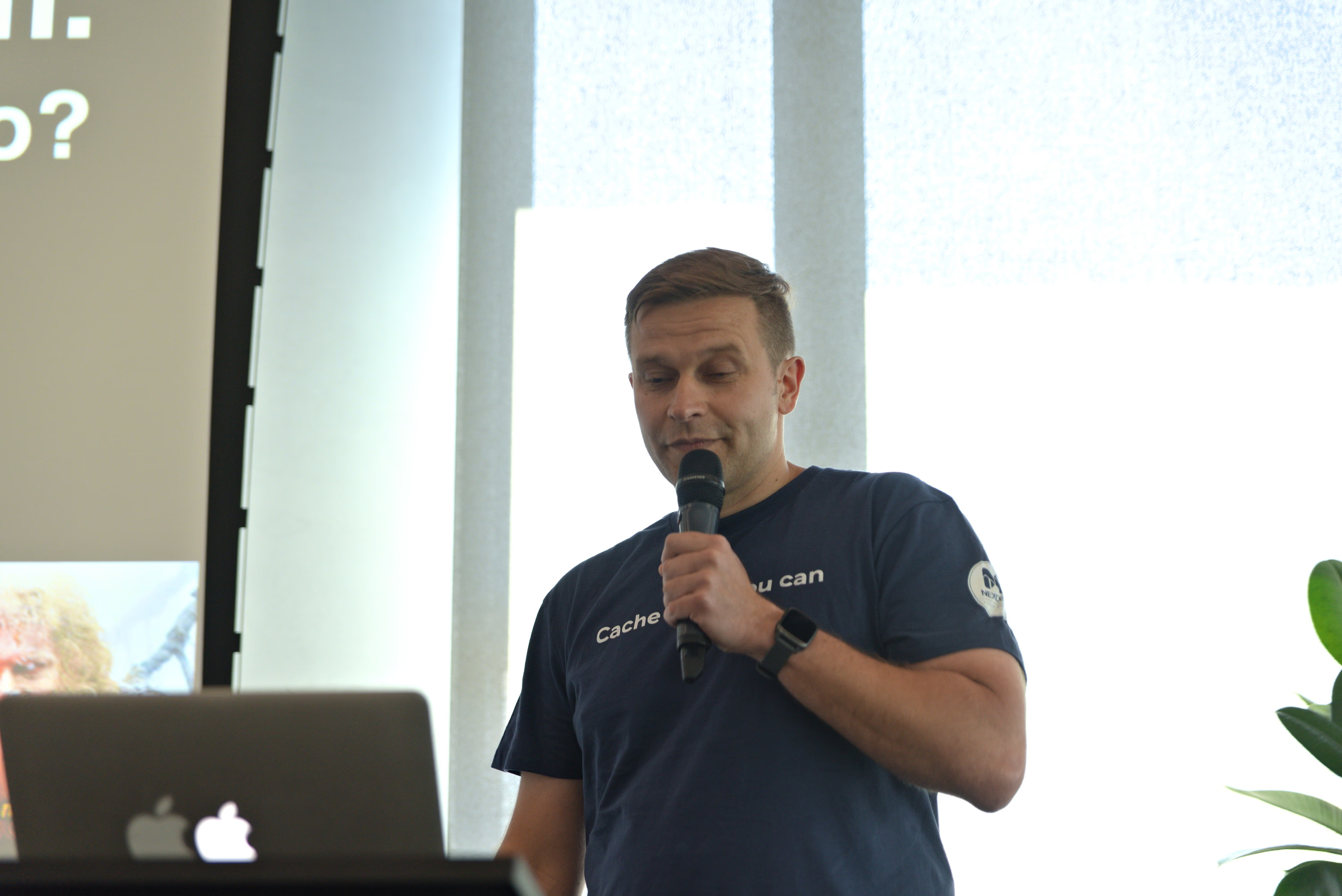
Alain Schlesser, Principal Architect at Yoast, summarized the philosophy behind the new feature in his characteristic way: “You can’t stop the AI wave, but you can direct it. Our integration with NLWeb puts you back in charge.”
This statement reflects Yoast’s strategic approach to AI issues. Instead of treating artificial intelligence as a threat, Yoast sees it as an opportunity to strengthen WordPress users’ position in the changing digital landscape.
Schema Aggregation is an answer to concerns of many website owners regarding the growing role of AI in information processing. Instead of allowing AI algorithms to arbitrarily interpret site content, Yoast gives webmasters tools for controlled information presentation.
Practical Aspects of Implementation
Requirements and Compatibility
To use Yoast Schema Aggregation, you need:
- Yoast SEO version 27.1 or newer
- WordPress version 5.8 or newer
- An active site with content (articles, products, authors)
The feature is compatible with most popular WordPress plugins and themes. Yoast has run regression tests against the broader plugin and theme catalogue so the schema graph does not collide with markup other plugins are already injecting.
Configuration and Optimization
After updating to Yoast SEO 27.1, Schema Aggregation works automatically. Users don’t need to take any additional configuration steps to benefit from the new feature.
However, for optimal results, it’s worth ensuring comprehensive structured data:
- Complete author profiles with photos and bios
- Add organization data in Yoast settings
- Configure schema for products (if you run a store)
- Add location data (if you have a physical business)
The Future of SEO and AI’s Role
Evolution of Search
The development of Yoast Schema Aggregation fits into a broader trend in the evolution of search. More and more users are using AI assistants to find information, ask questions, and make decisions. Traditional search engines are also integrating AI, which changes how results are presented.
In this context, data structuring becomes a key element of SEO strategy. Sites that offer clear, organized information in a format accessible to AI will have an advantage over those relying solely on traditional optimization methods.
WordPress Position in the AI Era
Yoast Schema Aggregation strengthens WordPress’s position as a future-ready platform. Collaboration with Microsoft NLWeb shows that the WordPress ecosystem is ready for AI-related challenges.
For businesses and website creators, this means that choosing WordPress with Yoast is investing in a solution that will evolve along with changing technological requirements.
Comparison with Traditional Schema Approach
Traditional Approach
In the traditional approach to structured data, each page contained its own set of schema data. Search engine bots had to visit each page individually to understand its content. This process was time-consuming and didn’t always lead to a complete understanding of the site structure.
New Approach with Schema Aggregation
Schema Aggregation simplifies this process by centralizing all data in one location. An AI agent can get a complete picture of the site without having to index each individual page. This significantly increases the efficiency and accuracy of information processing.
Summary
Yoast Schema Aggregation in collaboration with Microsoft NLWeb represents a breakthrough moment in the history of SEO for WordPress. This innovative feature not only simplifies data structuring but also prepares WordPress sites for a future where AI will play an increasingly larger role in content discoverability.
For WordPress site owners, this is an encouragement to invest in content quality and structuring. Schema Aggregation will automatically ensure that data is presented in a way that is accessible to AI systems, giving users an edge in an increasingly competitive digital environment.
We’ll be watching the development of this technology and its impact on the SEO ecosystem. In the meantime, we encourage all Yoast users to update their plugins and take advantage of the new capabilities.