In 2008, when this article was first published, the CMS market was the Wild West. WordPress was seen mainly as a blogging platform. Our original list recommended obscure systems like Frog CMS, SilverStripe, miaCMS, MoinMoin, ImpressCMS, and CMS Made Simple. Most of those names mean nothing to anyone in 2026.
Learn more about WordPress development services at WPPoland.
The CMS landscape has transformed completely. What was once a single category - “content management system” - has split into three distinct approaches: traditional CMS, headless API-first CMS, and SaaS content platforms. Here is where the market stands in 2026.
1. WordPress - the undisputed champion (over 40% of all websites)
Type: Traditional CMS with headless capabilities License: GPL (free, open source) Language: PHP Best for: Blogs, business sites, WooCommerce e-commerce, enterprise portals
WordPress powers over 40% of all websites on the internet. No other CMS comes close. The software is free; if you are comparing the hosted route, our WordPress.com pricing plans breakdown covers what each tier actually includes. Despite years of predictions about its decline, WordPress has grown by diversifying:
- Gutenberg Block Editor matured into a full site editing (FSE) system, reducing the need for page builders like Elementor
- WordPress REST API and GraphQL (via WPGraphQL plugin) enable headless usage with React, Astro, or Next.js frontends
- WooCommerce remains the dominant open-source e-commerce platform, powering 38% of all online stores
- WordPress 7.x roadmap includes native AI content assistance, improved media management, and deeper block theme capabilities
Strengths: Massive plugin ecosystem (60,000+), huge talent pool, proven enterprise scalability, WooCommerce e-commerce.
Weaknesses: PHP monolith architecture, security depends on plugin quality, admin UX lags behind modern tools, technical debt from 20 years of backward compatibility.
2026 verdict: WordPress is not going anywhere. It is the default choice for content-heavy websites, especially when non-technical editors need to manage content independently.
2. Drupal - the enterprise workhorse (0.7% of all websites)
Type: Traditional CMS with strong headless support License: GPL (free, open source) Language: PHP (Symfony) Best for: Government, healthcare, higher education, complex enterprise sites
Drupal occupies a distinct niche: large organizations with complex content modeling needs, strict accessibility requirements (WCAG 2.2), and dedicated development teams.
- Drupal 11 (released 2025) brought Symfony 7 compatibility, improved admin UX, and first-party headless support
- Drupal CMS initiative simplified the editorial experience, narrowing the usability gap with WordPress
- Strong adoption in government sectors across the EU and US (whitehouse.gov, europa.eu)
Strengths: Superior content modeling, fine-grained permissions, strong accessibility compliance, enterprise-grade security.
Weaknesses: Steep learning curve, smaller plugin ecosystem, expensive to develop and maintain, major version upgrades are painful.
2026 verdict: Drupal thrives in government and large enterprise but is losing ground to headless CMS platforms in the mid-market.
3. Joomla - the survivor (1.2% market share)
Type: Traditional CMS License: GPL (free, open source) Language: PHP Best for: Community portals, multilingual sites, association websites
Joomla was once WordPress’s main competitor. In 2026, it occupies a small but loyal niche:
- Joomla 5 modernized the codebase with PHP 8.1+ requirement and Bootstrap 5 admin
- Built-in multilingual support (without plugins) remains a genuine advantage over WordPress
- Strong community in specific regions (Europe, South America)
Strengths: Native multilingual, flexible ACL (access control), mature extension directory.
Weaknesses: Declining developer community, fewer extensions than WordPress, outdated perception limits new adoption.
2026 verdict: Joomla survives but does not grow. Existing Joomla sites will continue to be maintained, but new projects rarely choose Joomla over WordPress or a headless solution.
4. Ghost - the newsletter-first publisher (0.1% market share)
Type: Specialized publishing platform with headless API License: MIT (free, open source) Language: Node.js Best for: Independent publishers, newsletters, membership sites
Ghost made a smart strategic pivot. Instead of competing with WordPress on general CMS features, it focused on the creator economy:
- Native newsletter system with email delivery, rivaling Substack and Beehiiv
- Membership and subscription management built in (Stripe integration)
- Headless API (Content API and Admin API) enables custom frontends
- Ghost(Pro) managed hosting provides a turnkey solution for writers
Strengths: Beautiful writing experience, built-in monetization (memberships, newsletters), fast Node.js performance, clean API.
Weaknesses: Limited plugin ecosystem, not suitable for complex sites, no e-commerce beyond memberships.
2026 verdict: Ghost found its niche and serves it well. Ideal for solo creators and small publishers who need writing, newsletters, and memberships in one platform.
5. Strapi - the open-source headless pioneer (self-hosted)
Type: Headless CMS (API-first) License: MIT / Enterprise Language: Node.js (JavaScript/TypeScript) Best for: Custom web applications, multi-channel content delivery, developer-driven projects
Strapi pioneered the open-source headless CMS category and remains one of the most popular options:
- Strapi 5 (released 2025) rewrote the core in TypeScript, improved performance, and added content versioning
- Auto-generated REST and GraphQL APIs from content type definitions
- Plugin marketplace with 100+ community plugins (SEO, media library, translations)
- Strapi Cloud provides managed hosting as an alternative to self-hosting
Strengths: Mature ecosystem, large community, self-hosted option for data sovereignty, flexible content modeling.
Weaknesses: Resource-heavy for simple sites, requires JavaScript/TypeScript expertise, no built-in frontend (you bring your own).
2026 verdict: Strapi is the safe choice for teams that want an open-source headless CMS with a proven track record and are comfortable with Node.js.
6. Payload CMS - the TypeScript-first challenger (self-hosted)
Type: Headless CMS (API-first, TypeScript-native) License: MIT Language: TypeScript (Next.js) Best for: Modern web applications, TypeScript teams, Next.js projects
Payload is the fastest-growing open-source headless CMS in 2025-2026:
- Config-as-code approach: define content types in TypeScript files, get auto-generated APIs, admin UI, and type definitions
- Deep Next.js integration: Payload can run inside a Next.js application, sharing the same server process
- Payload 3.0 uses React Server Components for the admin panel, achieving excellent performance
- Built-in access control, localization, versions, drafts, and media management
Strengths: TypeScript-native with end-to-end type safety, excellent DX (developer experience), Next.js integration, fast-growing community.
Weaknesses: Younger ecosystem than Strapi, fewer community plugins, Next.js-centric (less ideal for non-Next.js stacks).
2026 verdict: Payload is the go-to choice for TypeScript-first teams building with Next.js. It represents the next generation of open-source headless CMS.
7. Directus - the database-first CMS
Type: Headless CMS (wraps any SQL database) License: BSL / GPL after 3 years Language: TypeScript (Node.js) Best for: Existing database projects, internal tools, data-heavy applications
Directus takes a unique approach: instead of defining content in a CMS, you point it at an existing SQL database and it generates an admin interface and API:
- Supports PostgreSQL, MySQL, MariaDB, SQLite, MS SQL, Oracle, and CockroachDB
- Auto-generates REST and GraphQL APIs from database schema
- Directus Cloud for managed hosting, or self-host on any server
- Extensive role-based access control with field-level permissions
Strengths: Works with existing databases, no vendor lock-in (your data is always in standard SQL), supports multiple database engines.
Weaknesses: Less opinionated (requires more decisions), admin UI can feel complex for content editors, smaller community than Strapi.
2026 verdict: Directus is ideal when you have an existing database and need a CMS layer on top of it. Not the best starting point for greenfield projects.
8. Sanity - the structured content cloud
Type: SaaS headless CMS (cloud-hosted) License: Proprietary (free tier available) Language: JavaScript/TypeScript (React-based Studio) Best for: Large content teams, multi-channel publishing, complex content structures
Sanity differentiates with real-time collaboration and a customizable editing studio:
- Sanity Studio is a React application you can fully customize and extend
- Real-time collaboration (Google Docs-style concurrent editing)
- GROQ query language provides powerful content querying beyond REST/GraphQL
- Content Lake stores structured content that can be queried and transformed for any channel
Strengths: Real-time collaboration, extremely flexible content modeling, customizable studio, powerful GROQ queries.
Weaknesses: Proprietary (vendor lock-in), costs scale with API usage and dataset size, requires developer to set up and customize studio.
2026 verdict: Sanity is excellent for large content teams that need real-time collaboration and complex content structures. The cost model requires careful evaluation at scale.
9. Contentful - the enterprise SaaS standard
Type: SaaS headless CMS (cloud-hosted) License: Proprietary (free tier available) Language: Platform-agnostic (REST/GraphQL APIs) Best for: Enterprise multi-brand management, global content operations, regulated industries
Contentful has established itself as the default enterprise SaaS headless CMS:
- Content Orchestration features for managing content across brands, regions, and channels
- Contentful Studio provides visual content assembly and preview
- App Framework allows custom integrations directly in the admin interface
- SOC 2, ISO 27001, GDPR enterprise governance documentation
Strengths: Enterprise-grade reliability, mature API infrastructure, strong enterprise governance documentation, extensive integration marketplace.
Weaknesses: Expensive at scale (pricing based on spaces, environments, and API calls), vendor lock-in, can feel over-engineered for small projects.
2026 verdict: Contentful is the safe enterprise choice for organizations that need SaaS reliability, compliance, and are willing to pay for it. Not suitable for budget-conscious projects.
10. Astro (Content Collections) - the developer-first approach
Type: Web framework with file-based CMS capabilities License: MIT (free, open source) Language: TypeScript/JavaScript Best for: Developer blogs, documentation sites, marketing sites, static-first content
Astro is not a traditional CMS, but its Content Collections feature provides CMS-like functionality for developer-managed content:
- Content Collections: type-safe, schema-validated Markdown/MDX files with frontmatter
- Content Layer API (Astro 5): load content from any source (files, APIs, databases) with unified type-safe access
- Zero JS by default: Astro ships no JavaScript unless you explicitly add interactive components
- Island Architecture: interactive components hydrate independently, achieving excellent Core Web Vitals
This very site (wppoland.com) runs on Astro with Content Collections for blog posts and service pages.
Strengths: Best performance (zero JS by default), type-safe content, any UI framework (React, Vue, Svelte), excellent developer experience.
Weaknesses: No visual admin interface for non-developers, content changes require code commits, not suitable for content teams without Git knowledge.
2026 verdict: Astro is ideal for developer-managed content sites where performance is a priority. It is not a replacement for WordPress or a headless CMS when non-technical editors need access.
Comparison matrix: 10 CMS platforms in 2026
| CMS | Type | License | Share of all websites | Headless | Visual Editor | Self-Hosted | Best For |
|---|---|---|---|---|---|---|---|
| WordPress | Traditional + headless | GPL | 40.8% | Via REST/GraphQL | Yes (Gutenberg) | Yes | General websites, e-commerce |
| Drupal | Traditional + headless | GPL | 0.7% | Yes (native) | Yes | Yes | Enterprise, government |
| Joomla | Traditional | GPL | 1.2% | Limited | Yes | Yes | Multilingual community sites |
| Ghost | Publishing platform | MIT | 0.1% | Yes (APIs) | Yes | Yes | Newsletters, memberships |
| Strapi | Headless | MIT/Enterprise | N/A | Yes (native) | Admin only | Yes | Custom web applications |
| Payload | Headless | MIT | N/A | Yes (native) | Admin only | Yes | TypeScript/Next.js projects |
| Directus | Headless | BSL | N/A | Yes (native) | Admin only | Yes | Existing database projects |
| Sanity | Headless (SaaS) | Proprietary | N/A | Yes (native) | Customizable | Cloud only | Large content teams |
| Contentful | Headless (SaaS) | Proprietary | N/A | Yes (native) | Yes (Studio) | Cloud only | Enterprise multi-brand |
| Astro | Framework + CMS | MIT | N/A | N/A (static) | No | Yes | Developer-managed content |
Percentages are the share of all websites. Source: W3Techs, 13 August 2026, which counts every row in this column on the same day. Among sites with a recognised CMS the same survey puts WordPress at 59.0%.
What is the best free CMS in 2026?
The best free CMS in 2026 for most sites is still WordPress, but the right free pick depends on who edits the content and how it is delivered. Of the ten systems above, only Sanity and Contentful are proprietary SaaS with limited free tiers; the other eight are free to self-host. Seven are open source under GPL or MIT, and Directus is source-available under the BSL (each release converts to GPL three years later). So the real decision is about editing model and stack, not licence cost.
Non-technical editors, general websites, e-commerce: WordPress (GPL). It carries the largest plugin ecosystem and WooCommerce, and among the free options it is the one a non-developer is most likely to run end to end without touching code. Ghost, Joomla, and Drupal also ship editor-friendly admins, but none pairs that with a comparable plugin and e-commerce ecosystem.
Newsletters, memberships, solo publishers: Ghost (MIT). Built-in email delivery and Stripe-based memberships mean you do not bolt on a third-party newsletter tool.
Government, complex content modelling, strict accessibility: Drupal (GPL). Fine-grained permissions and WCAG 2.2 compliance are first-party rather than plugin-dependent.
Native multilingual community sites: Joomla (GPL), which handles multiple languages without extensions.
If your content is API-first or developer-managed, the free pick changes to a headless option or Astro (see below).
What happened to the 2008 list?
For historical context, here is what happened to the original systems we recommended in 2008:
- Frog CMS: Abandoned. Last release 2009.
- SilverStripe: Rebranded to Silverstripe CMS. Still maintained, used primarily in New Zealand/Australia government projects.
- miaCMS: Dead. Forked from Mambo (Joomla’s predecessor), abandoned around 2010.
- MoinMoin: Still exists as a Python wiki engine but irrelevant as a CMS.
- ImpressCMS: Technically maintained but with negligible adoption.
- MODx (MODX): Still alive as MODX Revolution. Small, devoted developer community.
- Textpattern: Still exists with a tiny community. A minimalist’s choice.
- Radiant: Abandoned. Ruby-based, last meaningful update around 2014.
- CMS Made Simple: Still maintained, version 2.x. Small community.
- Liferay: Pivoted to enterprise Java portal/DXP platform. Serves banks and large corporations.
The lesson from 2008 is clear: ecosystems win, not features. WordPress won because it built the largest ecosystem of plugins, themes, hosting providers, and developer talent. The systems that survived (Drupal, Joomla) had their own ecosystems. Those that died focused on technical elegance without building a sustainable community.
How to choose: a decision framework
Choose WordPress if: You need a proven CMS with the largest plugin ecosystem, your content editors are non-technical, you need WooCommerce for e-commerce, or you want the widest hosting options.
Choose a headless CMS (Strapi/Payload) if: You need API-first content delivery, your frontend is built with React/Next.js/Astro, you publish content to multiple channels (web, mobile, IoT), or your development team prefers TypeScript.
Choose a SaaS CMS (Contentful/Sanity) if: You need enterprise enterprise governance documentation, real-time multi-editor collaboration, managed infrastructure, or you prefer predictable monthly costs over DevOps.
Choose Astro with Content Collections if: Your content is managed by developers through Git, performance is your top priority, your site is primarily static content (blog, documentation, marketing), or you want zero JavaScript overhead.
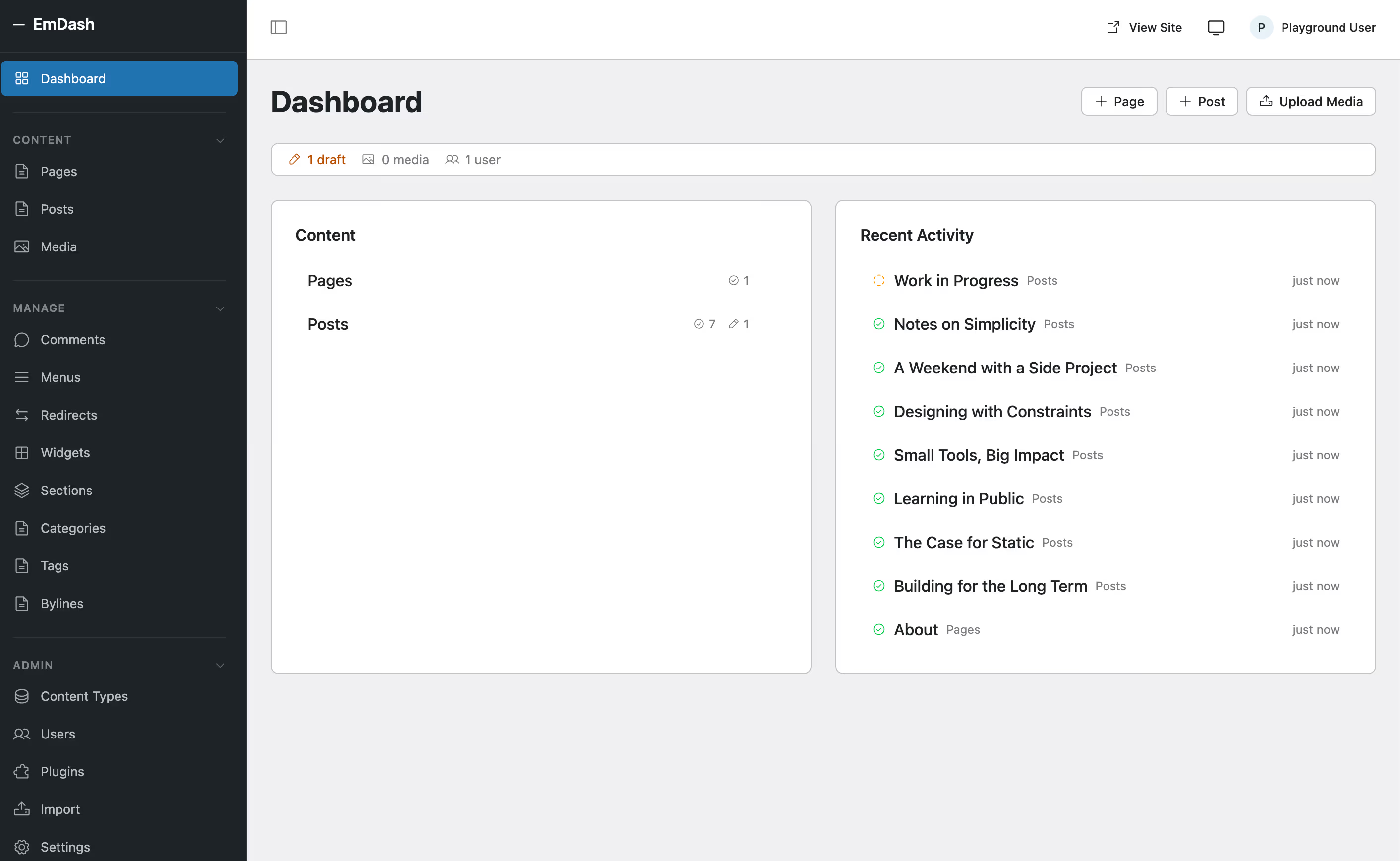
The CMS market in 2026 is not a winner-take-all race. Different tools serve different needs. In April 2026, Cloudflare entered the CMS space with EmDash, a TypeScript CMS built on Astro that introduces sandboxed plugin security. The best choice depends on your team, your content, and your users - not on market share or hype.
Which is the best open-source CMS for developers?
For developers, the best open-source CMS in 2026 depends on the stack: Payload for TypeScript and Next.js teams, Strapi for framework-agnostic Node projects, and Astro Content Collections for Git-managed static content. All three are free and open source (MIT), so the choice is about how you build the frontend, not the price.
Payload (MIT, TypeScript) is the strongest fit when you are already in Next.js. Config-as-code content types generate the API, admin UI, and end-to-end types from the same TypeScript files, and Payload can run inside the Next.js server process. The tradeoff is a younger plugin ecosystem and a Next.js-centric design.
Strapi (MIT, Node.js) is the safer choice when your frontend is not Next.js. It auto-generates REST and GraphQL from content types, has the larger community and plugin marketplace, and self-hosts for data sovereignty. It is heavier than Payload for small sites.
Directus (BSL, converts to GPL after three years) wins when you already have a SQL database and want an admin layer and API on top of it rather than a greenfield content model. Astro Content Collections (MIT) is the pick when developers own the content through Git and want zero-JS performance, at the cost of no visual admin for non-technical editors. For a purely open-source headless API layer, Strapi and Payload are the two to shortlist first.