Introduction
If there is one person in WordPress worth watching closely on testing, demo environments, and AI right now, it is Adam Zielinski. The reason is straightforward: WordPress Playground no longer looks like a clever side project for developers. It is starting to behave like a real infrastructure layer for a growing part of the ecosystem.
This is no longer just about running WordPress in a browser. Between March 10 and March 12, 2026, WordPress made several moves that fit together into one coherent story. First, Playground was presented as the fastest path for testing WordPress 7.0 beta 4. Then, on March 11, 2026, WordPress launched my.WordPress.net, a private and persistent browser-based WordPress environment. A day later, WordPress 7.0 Beta 5 arrived. That does not look like a side experiment any more. It looks like strategic direction.
That is why an article about Adam Zielinski makes more sense as an analysis of product change than as a standard profile piece.
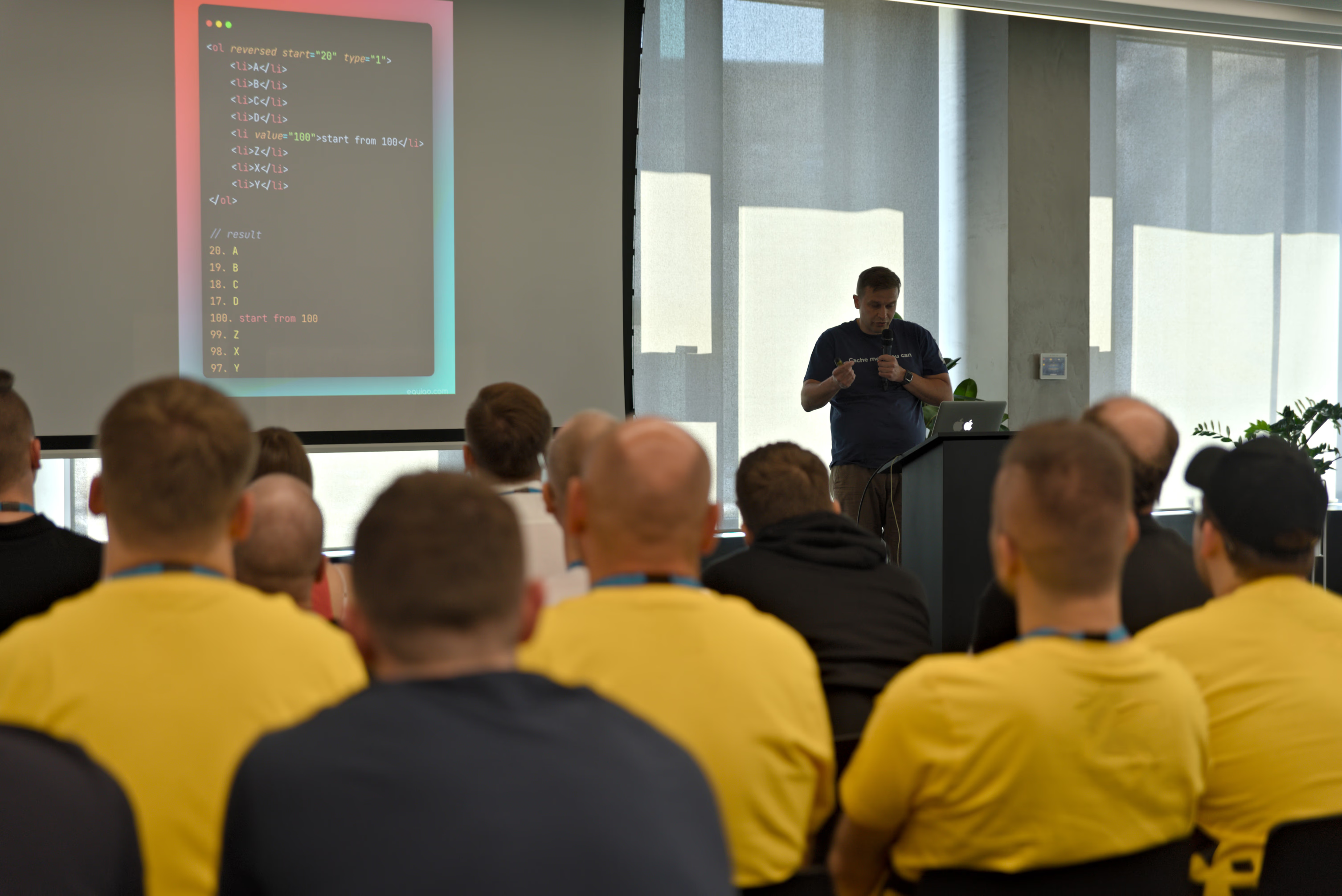
There is also another useful layer of context. Adam Zielinski is already listed in the speakers section on the official CMS Conf 2026 website. Even if the event did not yet have a dedicated blog post about his session, the official speakers section alone is enough to show that Playground is no longer a niche WordPress topic. It is becoming part of a broader conversation about the future of CMS platforms.
Key takeaways at a glance
If you want the shortest possible version of this article, these are the main points:
- Adam Zielinski matters because Playground is no longer a side experiment. It is becoming part of official WordPress workflow.
- my.WordPress.net shows that WordPress can operate as a private, persistent browser workspace, not only as a public site on hosting.
- Playground is becoming more important for beta testing, onboarding, product demos, QA, and safe AI experimentation.
- For agencies and software teams, this means lower testing costs, faster proof of value, and less friction at the beginning of projects.
- For SEO, GEO, and AEO, the real value is that cheaper experimentation can improve structure, iteration speed, and content quality.
Playground is changing its role
Until recently, the simplest way to describe WordPress Playground was as a sandbox. It was useful for quick tests, plugin demos, and education without local setup. That description is still true, but since March 2026 it has become too narrow.
The official WordPress post about my.WordPress.net points to a much wider ambition. WordPress runs there entirely and persistently inside the browser, without hosting, registration, or an early domain decision. Data stays local in the browser, and the environment is private by default. That changes the way people can think about WordPress itself.
Instead of the classic model of “set up a site and publish it to the world”, a different model appears: “enter WordPress and start working”. For some people, that means a notebook, a knowledge base, or an RSS reader. For others, it means a safe place for learning, testing, proof of concept work, and experiments with new workflows.
This is where Adam Zielinski’s work becomes especially important. Playground does not solve one isolated problem. It pulls together several old WordPress problems into one modern response:
- too much friction for new users,
- heavy and expensive demo environments for agencies and product teams,
- testing costs that remain too high for smaller teams,
- too much risk when experimenting with AI on production systems.
It is no longer just a developer tool
The most interesting part of this shift is that Playground is moving beyond purely technical audiences.
In the official post on WordPress 6.9.3 and 7.0 beta 4, WordPress listed Playground as one of the standard ways to test the beta release with no setup. That is an important signal. If the project itself treats Playground as an instant test environment for Core, then we are no longer talking about a novelty. We are talking about workflow.
At the same time, my.WordPress.net shows a second vector: the move from testing towards a private workspace. The wider WordPress 7.0 narrative adds a third vector: AI, connectors, and new content workflows.
In practice, this creates three very concrete use cases.
1. Demos and sales
An agency or plugin maker can show a real working product without maintaining a separate demo server. The client is not watching slides or a recording. They are clicking through an actual interface.
2. QA and support
Bugs can be reproduced faster because teams do not need to build a local environment from scratch every time. That can shorten support diagnosis and speed up regression testing.
3. AI without production risk
If WordPress wants to develop native AI workflows, it needs safe places for experimentation, integration, and iteration. Playground is naturally suited to testing changes without touching live sites.
What this means for SEO, GEO, and AEO
This topic should not be read only as a technical story. Site owners, content teams, and agencies increasingly care less about whether WordPress has “a new feature” and more about whether a change makes publishing faster, structures content better, reduces experiment cost, and improves visibility across search and AI-driven interfaces.
That is where Playground becomes genuinely interesting.
SEO
From a classical SEO perspective, WordPress Playground is not a ranking factor in itself. It will not push a page higher in Google just because it exists. What it can do is improve the process that leads to better SEO outcomes. If a team can test internal linking structures, landing page variants, block patterns, template changes, or structured data layouts faster, it can reach better decisions sooner.
In practical terms, that means:
- faster testing of information architecture,
- easier evaluation of category and article template variations,
- simpler experimentation with structured data implementation,
- lower risk of breaking production during technical SEO work.
That is not an SEO shortcut. It is a shorter path from hypothesis to validation.
If you want the broader visibility angle, also see my guide to AI search, GEO, and LLM citation optimisation for WordPress.
GEO
By GEO here I mean visibility in generative search environments, where AI systems build answers from multiple sources, cite websites, extract facts, and connect them to entities. To perform well there, content needs to be not only accurate but also easy to process.
Playground helps because it lowers the cost of experimenting with:
- question-and-answer structures,
- FAQ sections,
- fact boxes and concise summaries,
- clearer information arranged around entities,
- stronger internal linking between expert pieces.
For teams that want to create content aimed at AI citations, expertise alone is not enough. They also need the ability to iterate on format quickly. A browser-based WordPress environment can help with exactly that.
AEO
AEO, or Answer Engine Optimisation, rewards content that answers clearly, quickly, and with minimal friction. An article that can be scanned, summarised, and cited easily has an obvious advantage over one that is vague, bloated, or technically messy.
From that angle, Playground matters because it supports:
- faster prototyping of answer-focused articles,
- testing blocks for concise responses and key takeaways,
- building more modular templates for expert content,
- experimenting with AI-assisted workflows without touching production.
Again, none of this guarantees success. But it lowers the cost of reaching a better publishing model.
Why this matters for companies, not only for geeks
Many people still look at projects like this only through the lens of developer experience. That is too limited. For companies and marketing teams, the biggest value may lie elsewhere.
First, Playground shortens the distance from idea to working prototype. If a team wants to test a content workflow, a simple integration, or a new landing page structure, it does not necessarily need to involve a full staging environment immediately.
Second, it reduces the cost of entry into WordPress for people who previously bounced off hosting, configuration, or local environments. That matters not only for learning. It also matters for onboarding, workshops, and sales processes.
Third, it creates a strong base for new product types around WordPress. If browser-based environments become stable enough, teams can build onboarding flows, interactive tutorials, industry-specific demos, and more advanced private workspaces on top of them.
In that sense, Adam Zielinski’s vision is not just technical. It is economic. It changes the cost structure of working with WordPress.
Why this goes beyond WordPress itself
The reference to CMS Conf matters for another reason as well. This is not an event that exists purely inside the WordPress bubble. The fact that the topic appears in a broader CMS conversation suggests that Playground is starting to be seen as a signal of wider change.
The CMS market has been pulled between three major models for years:
- the classic hosted CMS with an admin panel and server-based workflow,
- the headless CMS focused on APIs and multi-channel delivery,
- newer AI-assisted environments where speed, orchestration, and experimentation matter more than heavy setup.
Playground does not replace every one of those models. What it does is cut across them in a very interesting way. It combines low-friction entry, fast prototyping, the openness of WordPress, and a path towards richer workflows without requiring full infrastructure on day one.
That means an article about Adam Zielinski is not only about one open-source project. It is about what the next generation of CMS work might look like.
What is actually new in this vision
The most interesting change is not simply that Playground can do more than it could a year ago. The deeper change is that WordPress itself is starting to use it as a foundation for subsequent product moves.
You can see that in several places at once:
- Playground supports Core beta testing,
- my.WordPress.net builds a private workspace on top of it,
- the WordPress 7.0 narrative increasingly connects the platform with AI and new editorial workflows,
- the browser is becoming a place not only for consuming content but for creating, learning, and experimenting.
From that perspective, The Repository’s framing of a shift “from experimental tool to AI infrastructure” feels accurate. Even if this is not yet a fully mature platform layer, the direction is already visible.
How companies can use it right now
The best thing about this kind of shift is that you do not have to wait for some final future state before gaining value from it. A meaningful part of the value is available already.
Faster pre-sales
Instead of explaining how something will work after delivery, you can show a working prototype. For many clients, that is the difference between an abstract promise and credible proof.
Better team onboarding
A new editor, marketer, or junior developer can get a safe environment to practise in without the risk of damaging a real project. That shortens onboarding and lowers stress inside the team.
Cheaper concept testing
Not every idea deserves a full staging rollout, and certainly not production exposure. Playground can become a “pre-staging” layer where weak ideas are rejected more cheaply and strong ones are refined sooner.
More courage in experimentation
Many organisations do not lack ideas. They lack safe places to test them. When the barrier drops, the number of useful experiments usually rises. From a growth perspective, that can matter more than any single new feature.
Where it is worth staying cautious
It is still important not to oversell any of this. WordPress is quite clear about the limitations of my.WordPress.net:
- starting storage is roughly 100 MB,
- the first launch takes longer because WordPress needs to download and initialise,
- data is local to the browser and device,
- each device has a separate installation,
- backups need to be downloaded manually.
That means Playground is not a replacement for traditional production hosting. It is not the right answer for every store, every publication, or every business process. But it does not have to be. It only needs to become the best place for testing, learning, quick environment creation, and safe experimentation.
That is a more mature claim than pretending everything should move into the browser immediately.
If you are looking at this from an operational perspective, it is also worth pairing Playground with a classic production safety plan, especially my articles on WordPress login, access, and recovery and WordPress security and performance best practices. Together, they make it easier to separate safe experimentation from real production responsibility.
There are also real tensions worth acknowledging:
- some agencies will need to rethink established delivery processes,
- not every client will understand the difference between a browser environment and production hosting,
- AI enthusiasm may outrun practical implementation discipline,
- teams may confuse a fast demo with production readiness.
Those are real risks, but they do not invalidate the direction. They simply show that technology often matures faster than the organisations that adopt it.
What to watch next
If this topic develops further in public, including around Adam Zielinski’s appearance at CMS Conf 2026 and other autumn conferences, three questions look especially important to me.
What is the path from browser to production?
The biggest business value will appear when a Playground prototype can move into staging or hosting with little friction.
How will AI use isolated environments?
Safe sandboxes for agents, generated changes, and automated tests are likely to become one of the most practical directions of development.
How much can WordPress simplify entry for new users?
If my.WordPress.net genuinely lowers the barrier to entry, it could become one of the most important product shifts in WordPress for years. Not because it solves everything, but because it changes the first contact with the platform.
How will this affect expert content operations?
This part still feels underestimated. If WordPress provides simpler environments for building, testing, and refining content, then the economics of expert publishing change as well. That matters directly for companies competing for organic visibility, AI citations, and lead generation through content.
Better workflow usually means:
- faster expert publishing,
- easier updates to older articles,
- more consistent content structure,
- simpler testing of templates aimed at featured snippets and answer engines.
If Adam Zielinski speaks more publicly about this dimension around CMS Conf 2026, the business and editorial angle may prove to be one of the most relevant for a wider audience.
Why this topic is worth following right now
There is one more reason to take this seriously now rather than later. In WordPress, the most important changes often do not arrive as one giant release. They come as a series of smaller moves that seem modest in isolation but change the logic of the platform when seen together.
That is exactly what March 2026 looks like:
- Playground is used for beta testing,
- my.WordPress.net introduces a new entry model for WordPress,
- WordPress 7.0 continues to push the AI and workflow narrative,
- Adam Zielinski’s topic is moving into a wider conference and media conversation.
That does not look accidental. It looks like the moment when a separate project starts turning into strategic infrastructure for the ecosystem.
Conclusion
Adam Zielinski matters today not only because he helped create an impressive technology. He matters because WordPress is beginning to build additional product layers on top of that technology.
In the week between March 10 and March 12, 2026, WordPress sent a very clear signal: Playground supports Core testing, powers a private browser workspace, and fits increasingly naturally into the AI conversation. This is no longer a side experiment for a small group of developers. It is a serious candidate for one of the most practical layers in modern WordPress.
If you want to understand where WordPress is actually going in 2026, watching Playground and people like Adam Zielinski will probably teach you more than simply tracking new block lists or cosmetic admin changes.
If you want the wider technical context, also see my article on WordPress Playground and my analysis of WordPress 7.0, AI, and real-time collaboration.